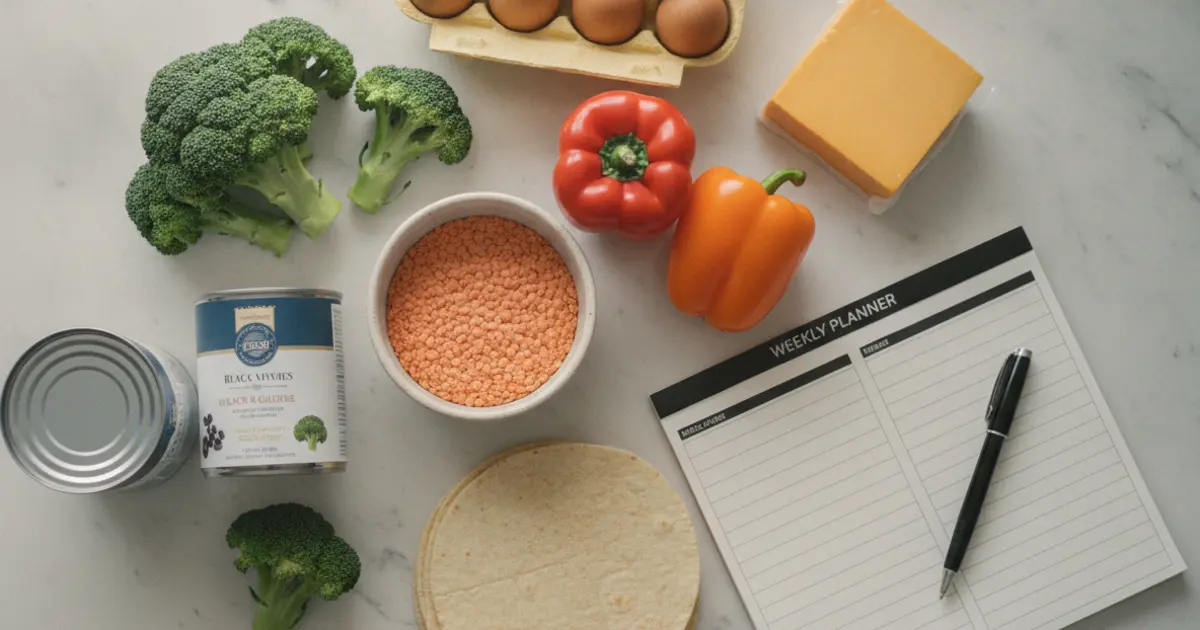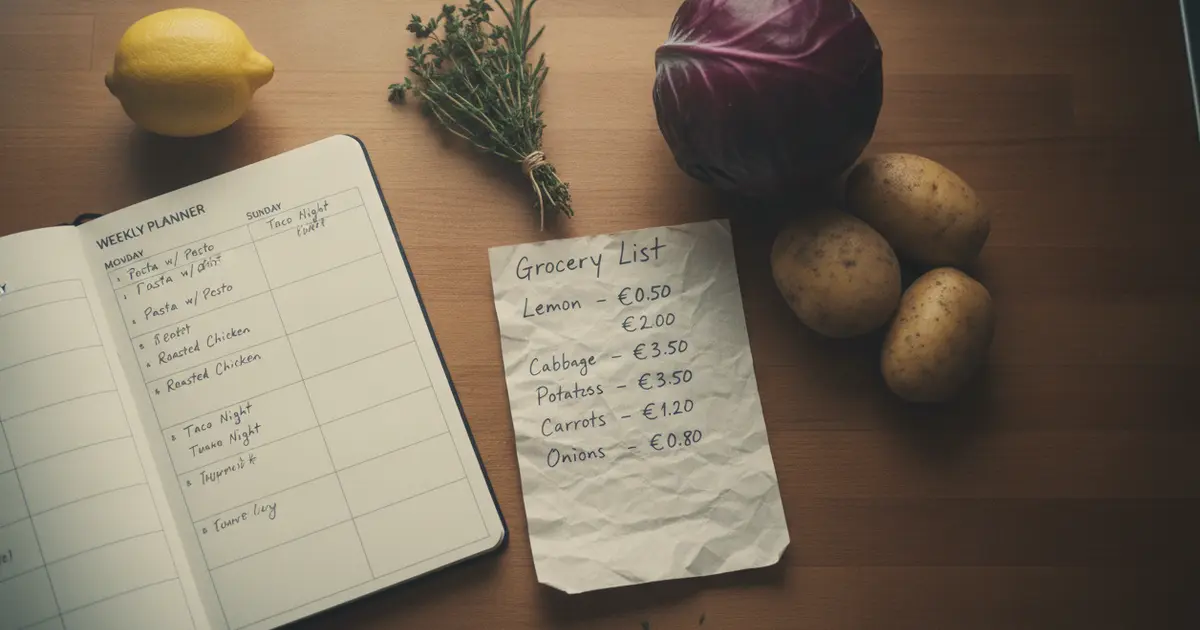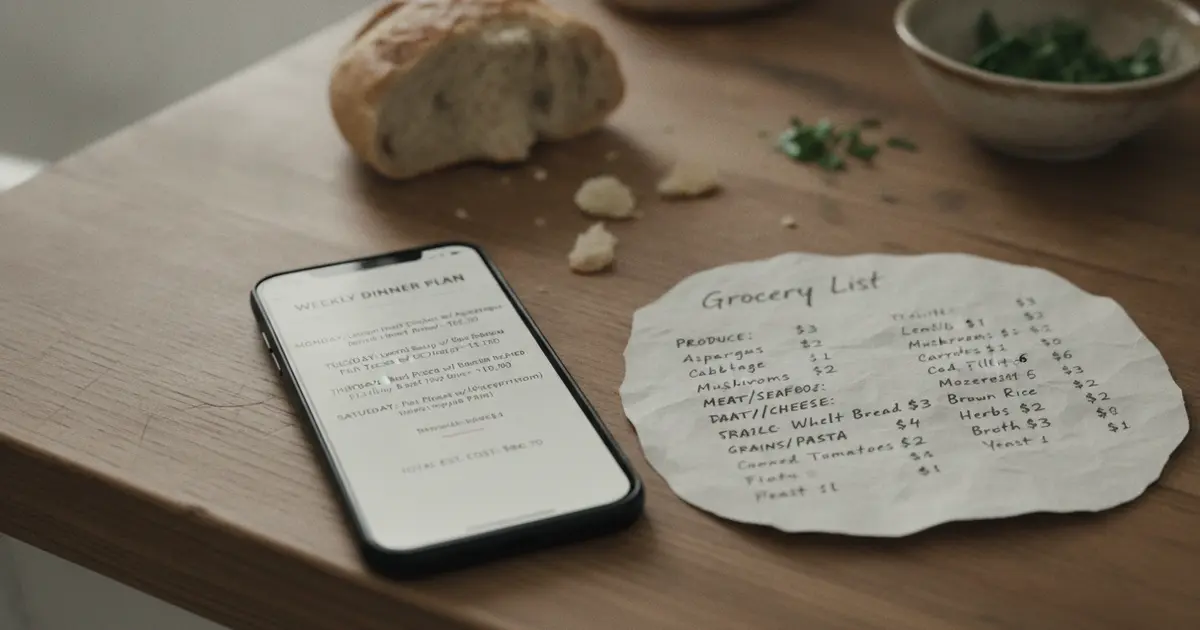

Want next week planned and priced? Mittsy is free.
Choosing what’s for dinner five nights in a row wears people down. Most families spend more time debating meals than cooking them, and the week ends with two uneaten proteins in the fridge and a takeout bill that didn’t need to happen.
A weekly meal planner for family dinners fixes this with one planning session. Spend 15 minutes on Sunday, and you’ll know what’s for dinner every night, what to buy, and roughly what it’ll cost before you leave the house.
A family weekly meal planner is a 7-dinner schedule built around your household size, your store, and a budget ceiling. Rotate proteins each night, build in one deliberate leftover night, and plan dinners before you write the list. Most families spend ~$80–$110 per week on dinners depending on store choice.
A Sample Week of Family Dinners
This plan serves 4. Adjust the servings count before building the grocery list — the quantities scale across every item.
| Night | Dinner | ~Cost (4 servings) |
|---|---|---|
| Monday | Sheet-pan lemon chicken thighs, roasted potatoes, broccoli | ~$22 |
| Tuesday | Ground beef tacos, corn tortillas, shredded cheese, salsa | ~$14 |
| Wednesday | Slow-cooker white chicken chili, sourdough bread | ~$18 |
| Thursday | Leftover chili night | ~$0 |
| Friday | Baked penne with Italian sausage and marinara | ~$13 |
| Saturday | Garlic butter shrimp stir-fry over jasmine rice | ~$20 |
| Sunday | One-pot beef and vegetable soup, crusty bread | ~$12 |
| Weekly total | ~$99 |
Thursday is a planned leftover night. Make a double batch of Wednesday’s chili — under 5 minutes of extra effort — and you’ve bought yourself a free dinner night.
These are estimated prices based on typical Walmart and Kroger shelf prices. Actual costs vary by store, region, and pack-size promotions. For a household of exactly 4, the meal plan for a family of 4 goes deeper on total weekly costs and specific serving math.
The USDA’s four food plan tiers (Thrifty, Low-Cost, Moderate, Liberal) show the spread in how American families actually spend. For a family of 4 in 2026, the Thrifty plan runs $191/week for all food, breakfast and lunch included. A dinners-only plan costs less. Families at the Thrifty level typically plan their meals in advance and shop from a list. Those at the Moderate level ($243/week for all food) are more likely to shop without a fixed plan. The gap between those two tiers is ~$52/week, or about $2,700/year. Decisions made at the kitchen table cost nothing; decisions made in the cereal aisle cost money. Research on grocery shopping behavior consistently finds that shoppers without a list spend 23–43% more per trip than those with one. A list built from actual meal names (rather than a general idea of “chicken and some vegetables”) tightens that further by cutting the items that looked useful but had no specific dinner to go into.
For the full 2026 USDA figures by household size, the USDA Food Plans guide has the complete tables.
The Aisle-Sorted Grocery List
The list below comes directly from the sample week above. It’s organized by store section so you move through the store once, without backtracking.
Produce
- Russet potatoes, 5 lb bag
- Broccoli, 2 heads
- Garlic, 1 bulb
- White onion, 2 medium
- Celery, 1 bunch
- Carrots, 1 lb bag
- Lemon, 1
Meat and Fish
- Chicken thighs, bone-in skin-on, 3–4 lb (Monday sheet-pan and Wednesday chili both use chicken)
- Ground beef, 80/20, 1 lb
- Italian sausage links, 1 lb
- Shrimp, 31–40 count, 12 oz bag (frozen works fine)
- Beef stew meat, 1 lb
Dairy
- Shredded Mexican cheese blend, 8 oz
- Parmesan, shredded, small bag
Bread and Bakery
- Sourdough loaf (Wednesday)
- Crusty French bread (Sunday soup)
Dry Goods and Canned
- Penne pasta, 1 lb box
- Jasmine rice, 2 lb bag (or use what’s in the pantry)
- Marinara sauce, 24 oz jar
- White beans, canned, 2 × 15 oz
- Chicken broth, 32 oz carton
- Beef broth, 32 oz carton
- Diced tomatoes, canned, 2 × 14.5 oz
- Corn tortillas, 30-count pack
- Salsa, 16 oz jar
Frozen
- Corn, 12 oz bag (for the chili)
If you already have butter, olive oil, garlic powder, cumin, and basic spices at home, cross those off before shopping. This list is also shorter because Wednesday’s chicken and Monday’s chicken come from one purchase.
That’s what an aisle-sorted list looks like when it’s built from specific meals rather than a general idea of what the week might need.
Your Weekly Meal Planner for Family: A 15-Minute Routine
The sample above is a template. Here’s how to build your own version in about 15 minutes.
Step 1: Check what’s already in the house (3 minutes). Pull open the fridge, freezer, and pantry. Proteins near expiration go on Monday. Half a box of pasta means pasta is probably Friday. A can of chickpeas is Tuesday’s dinner if you build around it.
Step 2: Pick your 7 dinners (5 minutes). Don’t put two chicken nights back-to-back unless one is a leftover night. Plan at least one easy dinner (sheet-pan, one-pot, or slow cooker) for the busiest weeknight. For more on how to build variety across 7 nights, the weekly dinner plan guide covers the protein rotation rules.
Step 3: Build the list (5 minutes). Write what each recipe needs and cross off what’s already in the house. Sort by aisle before leaving home.
Step 4: Set a budget ceiling (2 minutes). Decide the number before planning meals. A $90/week ceiling for a family of 4 is tight but doable at Aldi or Walmart. A $120/week ceiling gives more room. Write the number first, then pick dinners that fit it.
That’s 4 steps and about 15 minutes. If you do this for 4 weeks, you’ll have a rotation you can reuse without replanning. A blank template to fill in is available at Mittsy’s weekly meal planner tool, free to use without an account.
What Makes a Family Meal Planner Stick
Most meal plans fall apart by Wednesday. These four habits keep them on track.
Rotate proteins across the week. Chicken on Monday, beef on Tuesday, pork or fish on Wednesday: that works. Two pasta bakes in a row, or four consecutive chicken nights, is what makes people lose interest by Friday.
Lock in one theme night. Taco Tuesday, Friday pizza, Sunday soup: a fixed theme removes one decision from the week permanently. Theme nights survive schedule chaos because everyone already knows what’s coming.
Keep a flex night in the plan. Call one night “whatever’s left” and mean it. When the week gets busy, a flex night saves the plan. Trying to execute six consecutive fresh dinners when life intervenes leads to takeout.
Treat the pantry as inventory, not storage. An open jar of pasta sauce, half a bag of lentils, two cans of chickpeas: these are dinners waiting to happen. Checking the pantry before you plan (not before you shop) changes what meals you pick and shaves the list.
How Mittsy Builds Your Weekly Plan
Mittsy is a free meal planning app that runs the planner, grocery list, and pantry as one system. The free tier covers all three: a full cookbook, a week-strip planner, and an aisle-sorted grocery list, with no account required.
Here’s how a typical week comes together:
Open Mittsy and set your household size, your store (or two stores), and any dietary preferences. Browse the cookbook filtered by cuisine, vibe, appliance, or allergens. Add dinners to the week by tapping nights on the week strip, or tap “Rebuild” to regenerate the unlocked nights. The grocery list builds automatically: sorted by aisle, with pack-size rounding baked in (“1 bulb garlic”, “1 × 8.8 oz punnet cherry tomatoes”). Lock any night you know is takeout and that night disappears from the list entirely.
With Pro, the “Plan my week” feature generates all 7 dinners from your inputs: budget ceiling, household size, diet, dislikes, pantry contents, and which nights should be batch or leftover nights. Every recipe passes a validator, so you’re getting real dishes with ingredient math that checks out. Pro also adds estimated prices per line, per recipe, and per week, with a budget bar showing whether you’re over or under before you leave the house.
For a closer look at how the AI planning side works, the AI meal planner explainer covers it in full.
Free users see the first 2 AI-generated dinners before deciding whether to upgrade. The manual planner is free for everyone, forever.
Frequently Asked Questions
How many dinners should a weekly family meal plan include? Plan 7 dinners, expect to cook 5 or 6. Most families have one restaurant or takeout night and at least one intentional leftover night. Building 7 gives a complete grocery list without assuming perfect execution every night.
What’s a realistic weekly grocery budget for a family meal plan? For a family of 4, the USDA Thrifty Food Plan runs about $191/week for all food in 2026, breakfast and lunch included. A dinners-only budget is lower: roughly $80–$100/week covers 6 dinners at Aldi or Walmart. The grocery budget guide for a family of 4 breaks out the USDA ranges in full.
How do I stop wasting food when meal planning for a family? Buy proteins that pull double duty across two dinners. Chicken thighs on Monday for a sheet-pan and again Wednesday for a slow-cooker chili reduces the proteins you’re tracking and cuts waste. Plan one leftover night on purpose rather than hoping leftovers will appear.
Can I reuse the same weekly family meal plan every week? Yes. Most families settle into a rotation of 3 or 4 weeks. Keep a shortlist of the 10–12 dinners everyone actually eats, group them into weeks, and cycle through. Once built, each week takes under 5 minutes to reset.
What’s the best way to organize a family grocery list? Sort by store section before you leave home: produce, meat, dairy, dry goods. Moving through the store in order cuts time and cuts the impulse buys that come from walking the same aisle twice.
If the nightly dinner debate is wearing on your household, writing down the week’s dinners and the list that goes with them is the fastest fix. Start with the sample above, swap any nights your family won’t eat, and go from there. Mittsy builds the priced, aisle-sorted list automatically.