
Want next week planned and priced? Mittsy is free.
You put a reasonable week of food in the cart and hit $320 at checkout. For a family of four, groceries are usually the biggest variable in the household budget, and most families have only a rough sense of whether their number is normal. The USDA publishes monthly food cost estimates by household size, and for a family of four in 2026, the realistic range runs from ~$234 to ~$385 per week depending on how carefully you plan and where you shop.
A realistic grocery budget for a family of 4 in 2026 is $200-$310 per week. The USDA Low-Cost Plan targets ~$252/week, and the Moderate Plan targets ~$311/week, both for two adults and two school-age children. Thrifty households can hit ~$234/week. Where you shop and how much food gets wasted determines where in that range you land.
What the USDA Food Plans Say for a Family of 4
The USDA sets four food plan levels each month. For a reference family of four (two adults aged 19-50 and two children aged 6-11), the 2026 estimates are:
| Plan | Monthly | Weekly |
|---|---|---|
| Thrifty | ~$1,013 | ~$234 |
| Low-Cost | ~$1,092 | ~$252 |
| Moderate | ~$1,347 | ~$311 |
| Liberal | ~$1,668 | ~$385 |
The USDA adjusts food plan costs monthly based on retail food prices and household expenditure surveys. The Thrifty Plan reflects the cost basis for SNAP benefits and requires deliberate weekly planning to stay within. The Low-Cost Plan ($252/week) is the realistic floor for families who cook most meals at home and shop at discount or warehouse stores. The Moderate Plan ($311/week) fits families who shop at standard grocery chains without hunting every sale. All four plans cover food prepared at home only; they exclude restaurant meals, delivery, alcohol, and household supplies. Families in high-cost cities such as New York City, San Francisco, and Honolulu typically pay 25-35% above these national averages. The gap between Low-Cost and Liberal runs roughly $576/month, or about $6,900 per year. Teenagers eat at substantially higher rates than school-age children, so a household with two adults and two teens typically lands in the Moderate budget even with careful shopping.
These plans cover food only. Families who buy paper goods, cleaning supplies, and household items in the same cart often add $40-$80/month to the apparent food total. Keeping that mental separation makes the USDA benchmarks actually useful for comparison.
For a personalized starting number based on your household’s exact ages and sizes, the grocery budget calculator pulls USDA age-specific cost tables and builds a target for your household.
What $150, $200, and $250 a Week Actually Gets You
The dollar amounts mean more when you can see what they buy. Here’s what a family of four gets at three weekly tiers, assuming 5-6 home dinners per week with leftovers covering most lunches.
~$150/week (tight Thrifty range)
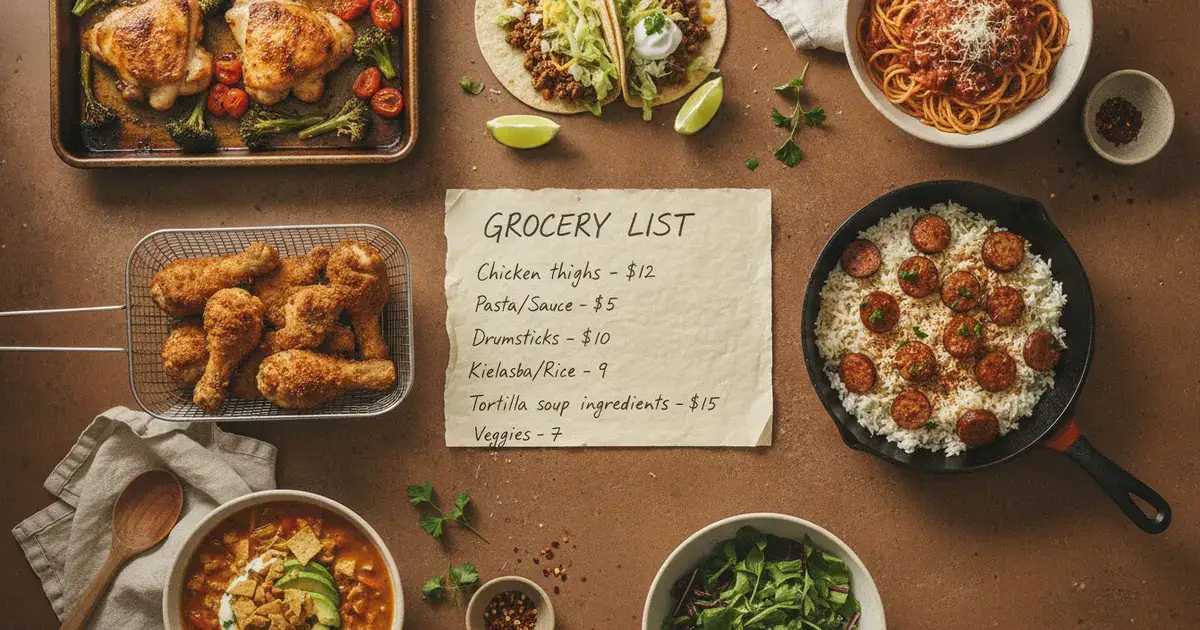
Chicken thighs, ground beef, eggs, dried beans, rice, pasta, frozen vegetables, and store-brand pantry staples. Every dinner is planned out in advance, waste is near zero, and pre-cut produce is off the table. A sample week: lemon herb chicken with roasted potatoes ($1.80/serving), spaghetti Bolognese ($1.40/serving), black bean tacos ($1.20/serving), and a slow cooker chicken soup that makes two nights ($1.10/serving). Aldi and Walmart are the stores where this number is achievable. At a standard grocery chain, the same cart typically costs $30-$50 more.
~$200/week (solid Low-Cost territory)
You can add salmon once a week ($2.80/serving), fresh produce, and a couple of specialty ingredients without going over. A week might include sheet-pan lemon chicken with potatoes ($5/night for four), turkey meatball pasta ($7/night), pork tenderloin with roasted broccoli ($9/night), a stir-fry built around produce that’s about to turn, and a big pot of chili that covers dinner plus two days of lunches. This is the tier where deliberate store choice matters most. The Aldi meal plan walks through a full priced week built at this level.
~$250/week (Moderate Plan territory)
More breathing room without strict sale-hunting. Protein variety opens up: shrimp, salmon, a nicer cut of beef once or twice a month. Organic produce for the highest-pesticide items (strawberries, spinach, apples) fits the budget. Shopping at Kroger or a standard chain without tracking every sale doesn’t push you over.
These are calibration checks, not prescriptive menus. If you’re spending $280/week but eating at the $200 tier, something’s slipping through.
Grocery Budget for Families of 3 and 5
The USDA reference family has two adults and two school-age children. Most households don’t match that exact profile.
Family of 3: Two adults and one school-age child land around ~$820-$870/month on the Low-Cost Plan, or roughly $189-$200/week. A third member who’s a teenager rather than a young child adds $60-$80/month to that baseline.
Family of 5: Add one more school-age child and the Low-Cost target climbs to roughly $1,300-$1,380/month (~$300-$318/week). Two adults and three teens pushes into Moderate Plan territory automatically, even with careful planning.
A per-person rule of thumb that works across household sizes: budget ~$50-$65/week per adult and school-age child, and ~$40-$50/week for children under 6. Add up your household and you have a starting target that’s more accurate than the reference family numbers.
5 Places Families Overspend Without Realizing It
You can shop at the right stores and still come in over budget. These are the spots that don’t show up until you look back at a full month of receipts.
Pre-cut and pre-portioned produce. Pre-cut butternut squash runs roughly double the price of whole. Bagged salad greens cost about 40% more than a head of romaine. The convenience is real, but so is the markup across an entire weekly cart.
Too many trips. Unplanned purchases account for roughly 40% of in-store spending, according to consumer behavior research. Every extra trip hands you another opportunity to buy things that weren’t on the list.
Protein inflation. Ground beef is up about 72% since 2020. Chicken thighs, pork shoulder, canned tuna, and dried beans are the budget proteins right now. Eggs remain the best per-serving value at most stores when they’re available.
Food waste. The average American household throws away roughly $254 worth of food per month. Batch cooking, using pantry items before buying more, and planning a “use it up” night once a week cut waste before it starts.
Name brands on staples. Store-brand canned tomatoes, pasta, frozen vegetables, and cooking oil perform identically to name brands in most grocery tests. Store brands average about 25% less. Switching on staples alone can save $30-$50/month.
How to Plan a Week of Dinners Under Your Grocery Budget
Planning before you shop is the single biggest lever on weekly spending. When you know what’s for dinner on Wednesday, you don’t buy the things Wednesday never needs.
A framework that works for four people:
- 2 nights around a cheaper protein: chicken thighs, eggs, beans, or pork shoulder
- 1 batch night: a bigger pot of chili, soup, or a sheet-pan dinner that covers tomorrow’s lunch too
- 1 “use it up” night: stir-fry, frittata, or fried rice built around whatever produce is closest to turning
- 2 nights with a midrange protein: salmon, ground beef, shrimp
Build the list from the plan, grouped by aisle so you make one pass through the store. If you shop at two stores (Aldi for produce and pantry staples, Kroger for meat and dairy, for example), split the list by store before you leave. Trying to sort it out in the moment doesn’t work.
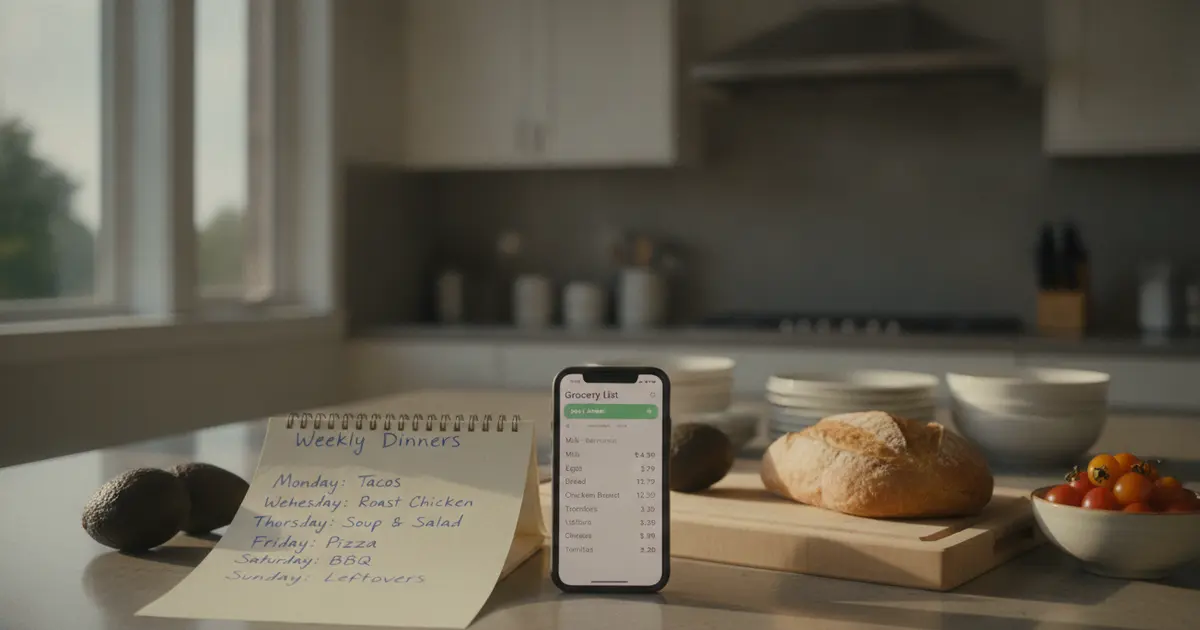
The weekly meal planner template has a free printable format to map out the week in one place, dinner by dinner.
How Mittsy Helps You Know the Total Before You Shop
Most families care about their grocery spending. The problem is that you don’t know what a week of food costs until you’re at the register.
Mittsy builds a week of dinners around your household size, weekly budget, diet, and the store you actually shop at. Every line on the grocery list carries an estimated price for your store, so you can see the total before you leave the house. If it’s over budget, you can swap one dinner (something cheaper, something that uses what’s already in the pantry) until the number fits. All estimates carry a ”~” prefix, the same way the app shows them.
The grocery list is aisle-sorted by default. If you shop at two stores, the list splits by store tab automatically. Pantry items come off the bill, so olive oil and canned tomatoes you already have at home don’t get added again.
Mittsy’s free tier covers the cookbook, the weekly planner, the grocery list, and the pantry. Price estimates by store and the AI-generated week are part of Mittsy Pro. Download Mittsy on iOS or Android and see what next week costs before you leave the house.
Frequently Asked Questions
What is a good weekly grocery budget for a family of 4?
A good target in 2026 is $200-$250 per week. The USDA Low-Cost Plan puts the benchmark at ~$252/week for a reference family of four. Families shopping at Aldi or Walmart can often hit the lower end of that range. Standard grocery chains tend to push weekly spending toward $250 or above, even with careful planning.
How can I lower my grocery bill for a family of 4?
Four moves with the most impact: plan a full week of dinners before you shop, cut store trips to once or twice per week, buy whole produce instead of pre-cut, and switch to store brands on staples. Batch cooking one dinner per week into leftovers also cuts per-meal costs significantly.
What does the USDA Low-Cost food plan include?
The USDA Low-Cost Plan covers food prepared and eaten at home for all meals and snacks. It excludes alcohol, restaurant meals, delivery, takeout, and household supplies. For a reference family of four (two adults aged 19-50 and two children aged 6-11), the 2026 Low-Cost target is $1,092/month ($252/week).
How much should a family of 3 spend on groceries?
On the USDA Low-Cost Plan, a family of three (two adults and one school-age child) should budget roughly $820-$870/month, or ~$189-$200/week. If the third member is a teenager rather than a younger child, add $60-$80/month to that baseline.
Why does my grocery bill stay high even when I meal plan?
Usually one of four culprits: pre-cut produce markup (about 40% higher on average), extra store trips that add unplanned items, food waste from produce that doesn’t get used before it turns, or mixing household supplies into the food total. Check each one before assuming the meal plan itself is the problem.