
Want next week planned and priced? Mittsy is free.
It’s 5 p.m. and you don’t know what’s for dinner. There’s chicken in the fridge, half an onion on the counter, and a vague sense you should have sorted this out earlier. This plays out every week for millions of households, not because of a lack of time but because no one planned ahead.
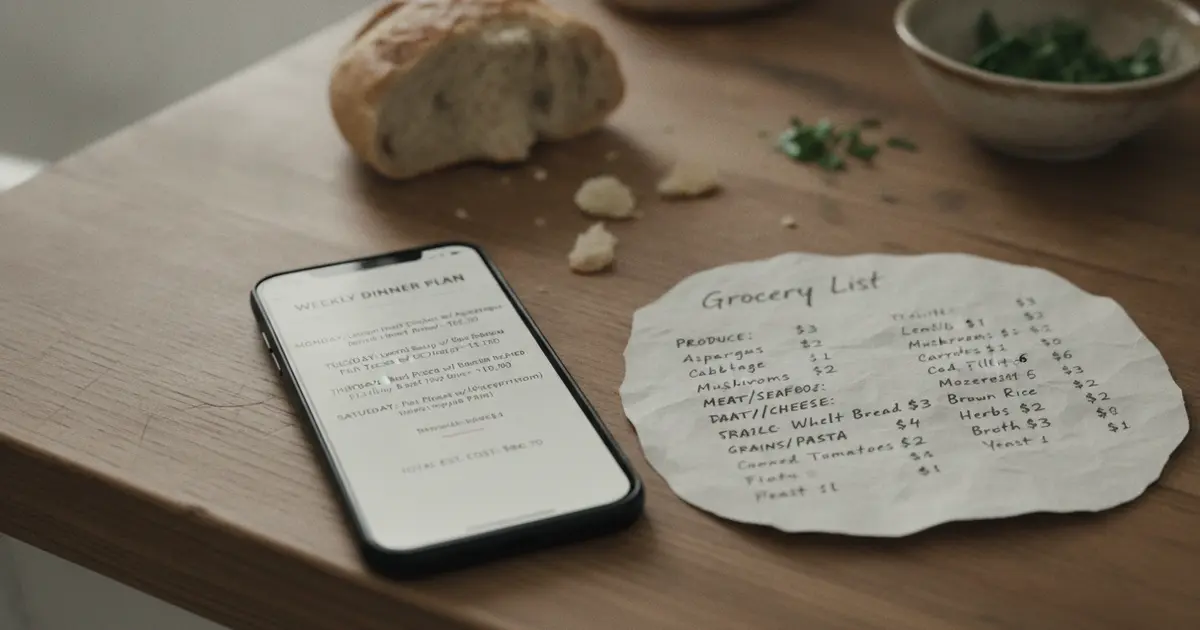
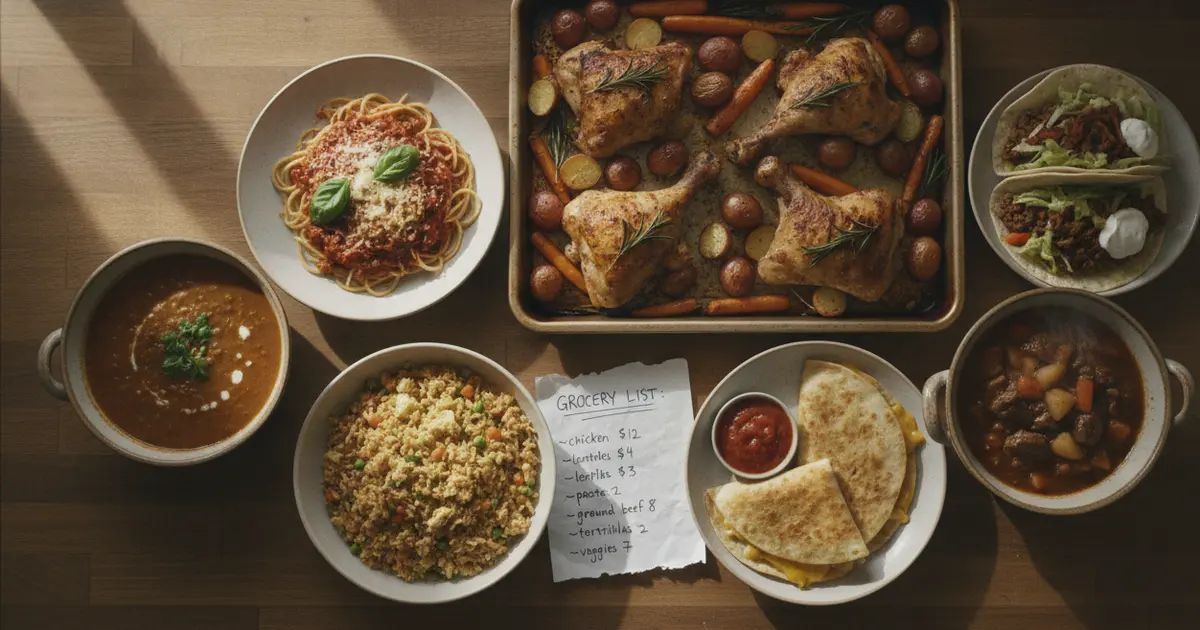
A weekly dinner plan fixes that before the week starts. Spend 15 minutes on Sunday choosing 7 dinners, write one grocery list, make one store trip, and every weeknight becomes a straight line from the fridge to the table. This guide walks you through how to build a weekly dinner plan that holds: a protein-rotation rule, a sample 7-night schedule with estimated costs, and a method for turning the plan into a grocery list you can actually shop from.
A weekly dinner plan is a list of 7 dinners decided before the week starts. Build one by counting your real cooking nights, picking one protein per night with no back-to-back repeats, blocking in a batch night and a quick night, then writing a grocery list from those recipes. Most households can do this in 15 minutes on Sunday.
Why Most Weekly Dinner Plans Fall Apart
The typical plan dies by Wednesday. You planned Monday and Tuesday, cooked them, then got tired and ordered out Thursday.
The reasons tend to be the same:
- Every dinner needs fresh ingredients bought that day
- No leftover nights or fast fallbacks built in
- The grocery list was built from memory, so something’s always missing at the store
A plan that works needs forgiveness baked in from the start. That means designating one night for a quick meal under 30 minutes, one for leftovers, and one “batch night” where you cook extra portions on purpose. The other four nights are regular dinners.
Planning also takes too long when you start from scratch every week. A weekly dinner plan template — even a simple list of 7 slots labeled by night — cuts planning time from 40 minutes to 15. You’re filling in blanks, not designing from zero.
How to Build a Weekly Dinner Plan
This system works for one person, two people, or a family of four.
Step 1: Count your actual cooking nights
Look at the week ahead. Monday through Friday isn’t five cooking nights if Wednesday has a school event and Saturday is dinner out. Count the nights you’ll realistically cook — most households land on 4 or 5.
Step 2: Pick one protein per night, no repeats back to back
Protein variety is the single best predictor of a plan you’ll actually follow through the week. A simple rotation for five nights: chicken, beef or pork, fish or eggs, chicken, beef or pork. No exotic proteins required.
Step 3: Block a batch night
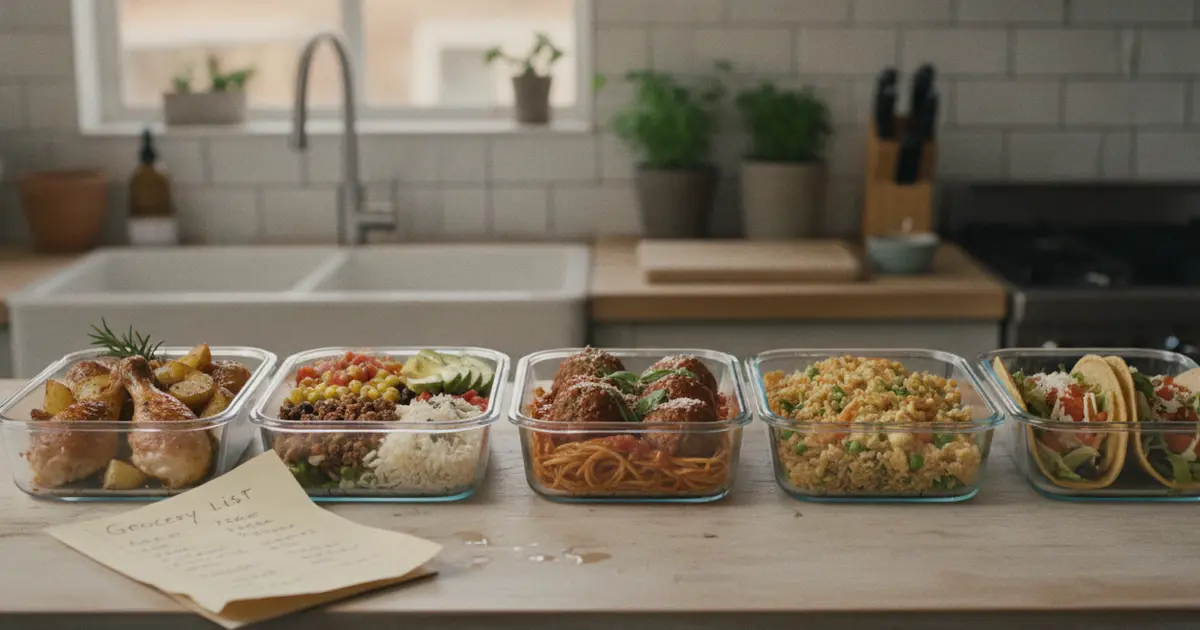
Pick one night (Sunday works for most) to cook something large: a pork shoulder in the slow cooker, a big pot of chili, a sheet-pan chicken with extra portions. Plan to reuse those leftovers two nights later as a different meal. A pulled pork shoulder on Sunday becomes pulled pork tacos on Tuesday. One cooking session, two dinners. This is the “cook once, eat twice” approach.
Step 4: Block a quick night
Wednesday or Thursday is usually the hardest night to cook. Reserve one slot for something under 30 minutes: egg fried rice, quesadillas, a stir-fry from pantry staples. Knowing you have a fast night mid-week is what keeps the plan from derailing when things get busy.
Step 5: Build the grocery list from the recipes
Write down every ingredient each dinner needs. Cross off what’s already in your pantry. Group what’s left by section: produce, meat, dairy, canned and dry goods. That list is your shopping trip.
A weekly dinner plan built around a protein rotation, one batch night, and one quick night costs roughly $80 to $130 per week for a family of four, depending on store and protein choices. USDA food plan data (2025) puts the thrifty plan at around $187 per month for a family of four (ages 9 to 11 and two adults), which works out to about $47 per week. The moderate plan runs around $283 per month, or about $71 per week. A home-planned week of 5 real dinners (chicken thighs, ground beef pasta, salmon, egg quesadillas, and a slow-cooker pork shoulder) typically lands between $55 and $90 at a mid-range grocery store like Kroger or Walmart when built around whole proteins and pantry staples. The grocery list from those 5 dinners covers 18 to 24 items, depending on pantry contents. Building the list before the store trip rather than shopping from memory reduces food waste and unplanned purchases. A weekly dinner plan template cuts Sunday planning to 10 to 15 minutes for most households.
A Sample Weekly Dinner Plan (7 Nights, ~Priced)
This sample is sized for four people. Prices are estimates based on typical shelf prices at a mid-range US grocery store — the actual total will vary by store and region.
| Night | Dinner | Protein | ~Cost (4 servings) |
|---|---|---|---|
| Sunday | Slow-cooker pulled pork shoulder with coleslaw | Pork | ~$13.00 |
| Monday | Sheet-pan lemon chicken thighs with roasted potatoes | Chicken | ~$10.50 |
| Tuesday | Leftover pulled pork tacos (tortillas and fixings) | Pork (leftover) | ~$4.50 |
| Wednesday | Spaghetti with ground beef marinara | Beef | ~$9.00 |
| Thursday | Egg fried rice with frozen peas and carrots | Eggs | ~$5.50 |
| Friday | Baked salmon with roasted broccoli | Fish | ~$16.00 |
| Saturday | Ground turkey stir-fry with rice | Turkey | ~$11.00 |
Weekly total: ~$70 for 7 dinners (4 people)
A few notes on this plan:
- Sunday’s pork shoulder produces enough protein for a full second dinner on Tuesday. That drops the effective per-serving cost on both nights.
- Thursday’s egg fried rice is the quick night. Most of the ingredients (eggs, frozen vegetables, soy sauce, cooked rice) are pantry staples you already have.
- Friday’s salmon is the most expensive night. If the budget is tight, swap it for a second chicken night using a different cut and preparation, and the weekly total drops to around $55 to $60.
This plan isn’t meant to be copied verbatim. The proteins and dishes change each week; the slot structure stays the same. For a version focused specifically on feeding a family of four, see our full meal plan for family of 4 with per-night costs and a complete grocery list.
From Plan to Grocery List
Most weekly dinner plans stop at the meal list. The grocery list is where the plan actually succeeds or breaks down.
The fastest method: go through each dinner and list every ingredient it needs, consolidate duplicates (if two dinners use garlic, combine the amounts), cross off what’s in your pantry, then group what’s left by store section.
A list grouped by aisle takes about 20 minutes to shop. An unorganized list takes 40. That difference compounds over 52 shopping trips per year.
Budget check: add rough cost estimates to the list as you build it. If the total looks high, the protein column is usually where the money is. Swapping salmon for an extra chicken night, or using chicken thighs instead of chicken breasts, can cut $10 to $15 from the weekly total without changing the plan structure.
For couples scaling this down to two servings, the same system applies. See our grocery budget for two for realistic weekly ranges and a sample week sized for a two-person household.
If you shop at Aldi, the same 7-dinner structure typically runs $15 to $20 less per week than at a conventional grocery store. Our Aldi meal plan shows a priced 7-night example built specifically around what’s on Aldi shelves.
How Mittsy Builds the Weekly Dinner Plan for You
Building the plan and list from scratch each Sunday takes 15 minutes if you know what you’re doing. Mittsy does it automatically if you’d rather spend those 15 minutes doing something else.
You tell the app your household size, your stores (up to two from chains like Walmart, Kroger, Aldi, Costco, Trader Joe’s, and others), and how many nights you’ll cook. You set appliance preferences (hob, oven, air fryer, slow cooker) and any allergens to filter out. The app’s weekly planner lets you add, move, and duplicate recipe slots, lock nights you’ve already decided on, and designate batch nights for “cook once, eat twice” leftovers.
With Mittsy Pro, the “Plan my week” feature generates 7 real dinners around your budget and preferences: no two consecutive nights share a protein or cuisine type, and batch nights are planned into the week on purpose. The grocery list comes out sorted by aisle, with pack sizes that match what’s actually on the shelf (“1 × 8.8 oz punnet of cherry tomatoes” rather than just “cherry tomatoes”). Every ingredient line shows an estimated price, and a budget bar shows your weekly total against your target before you leave the house.
The free tier (cookbook, planner, aisle-sorted list, and pantry) works without an account and without paying. Pro adds the AI-generated plan and per-ingredient price estimates. Download Mittsy for iPhone and Android at mittsy.app.
Frequently Asked Questions
How many dinners should a weekly dinner plan include?
Plan for the nights you’ll actually cook, usually 4 to 5 for most households. One night for leftovers and one for eating out leaves 5 real cooking slots. Fewer planned nights means less food waste, not less success with the plan.
What’s the best structure for a weekly dinner plan?
A reliable structure has one batch night (cook extra, reuse the protein two nights later), one quick night under 30 minutes, and no two consecutive nights with the same protein. Fill the remaining slots with regular dinners based on what you’ll shop for that week.
How much does a weekly dinner plan cost for a family of 4?
A home-planned week of 5 dinners for four people runs roughly $55 to $90 at a mid-range US grocery store, depending on protein choices and pantry staples on hand. Building the grocery list from the plan before you shop consistently keeps costs closer to the lower end of that range.
What’s a good quick dinner for a weekly plan?
Keep one slot for a dinner that takes 30 minutes or less: egg fried rice, quesadillas with rotisserie chicken, a pantry stir-fry, or pasta with jarred sauce and ground beef. These quick nights are what keep the rest of the plan alive when the week gets hard.
Build the Plan Before Sunday Ends
A weekly dinner plan doesn’t need to be complicated. Count your cooking nights. Pick your proteins. Block one batch night and one quick night. Write the grocery list from the recipes before you go shopping.
If you’d rather skip the setup and have the plan built around your store, budget, and household, Mittsy handles it in a few taps. Download the app at mittsy.app and have this week’s dinners sorted before the day runs out.